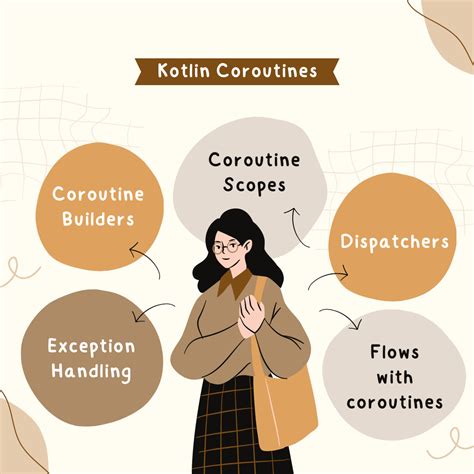
Coroutines are executed within a thread! co_await: Suspends the coroutine until the awaited operation completes. co_yield: Suspends the coroutine and returns a value to the caller. co_return: Signals the end of the coroutine's execution. Benefits of Coroutines: Non-blocking Execution: Coroutines allow for concurrent tasks without blocking the main thread.
How to fix it? A coroutine (also called a generator) can have control enter and leave it multiple times during a single function call. You can call it, but then the function can yield control back to the caller and suspend itself. The caller can then at a later point resume the coroutine call, and this can go back and forth a number of times. The coroutine.
What is coroutines kotlin
Coroutines offer a way to structure code that works asynchronously without the complexities of manual state management or complex callback functions. This article will explore the role of coroutines in Object-Oriented Programming (OOP), particularly in designing asynchronous objects in C++20. A high-level coroutine explanation : r/cpp - Reddit If there is any chance you will need to stop a Coroutine because something happens, then you need to store it and then call StopCoroutine later - which can be complicated. Back to the same example: let's say there is a non-zero chance that the object will stop fading for whatever reason, or reverse fading out and actually fade back in.What are Coroutines? : r/learnprogramming - Reddit Depends on how you do it. If you need to synchronize across suspension points, you even need a special coroutine mutex. If coroutines can run on different threads (e.g. on a multithreaded executor), synchronization is required for access to shared resources.C++20 Coroutines — Complete* Guide : r/cpp - Reddit Coroutine-based paradigm is the now and feature of network programming. Coroutine is light-weight thread which has its own stack, not managed by Operating System but QtNetworkNg. Like thread-based paradigm, send()/recv() is blocked, but switch to another coroutine in the same thread unitl data arrived. Many coroutines can be created at low cost. Benefits of coroutines
A coroutine consists of exactly the same information as a thread. The OS may suspend the execution of a thread at any point. It happens through low-level mechanisms like CPU trap signals/interrupts, which make the CPU go execute some other code than the thread's. How are coroutines implemented
Coroutines are fine. The problem is people use them incorrectly. For example, you shouldn’t make a new coroutine all the time when you can just cache the coroutine and start it again (all devs should be wary of the new keyword in general if they’re worried about memory and GC). Types of coroutines
Depends on how you do it. If you need to synchronize across suspension points, you even need a special coroutine mutex. If coroutines can run on different threads (e.g. on a multithreaded executor), synchronization is required for access to shared resources. What is coroutine python
Coroutine is light-weight thread which has its own stack, not managed by Operating System but QtNetworkNg. Like thread-based paradigm, send ()/recv () is blocked, but switch to another coroutine in the same thread unitl data arrived. Many coroutines can be created at low cost.
Coroutine scheduler
Coroutine boosts concurrency and provides a low-cost alternative to multithreading. Since every coroutine is a function, it uses the system stack to store its context. It doesn’t incur spawn and kill costs and is handled at the user level.
Standalone coroutine
Coroutines are functions that are cooperative, functions where the control of how runs are made by the “user” and not the OS, so you can have the same effect of using different threads without.